
Somewhere around the fourth tab, a part of you started keeping score. It reads for the one that sounds safe and braces against anything that sounds like a pitch. That part is doing its job, and it gets a say here.
You can tell whether a Spokane therapist · IFS therapy for adults (virtual) provider is right for you by checking four things: their training, what they focus on, how the first call feels, and whether cost and logistics line up. A free 15-minute consultation usually tells you more than a profile ever will.
TL;DR Quick Answers
Spokane Therapist · IFS Therapy for Adults (Virtual)
A Spokane therapist offering IFS therapy for adults (virtual) is a Washington-licensed counselor based in Spokane who uses Internal Family Systems to help adults get to know their protective parts, such as worry or a harsh inner critic, over secure video anywhere in Washington.
Who it's for: Adults carrying trauma, high-functioning anxiety, perfectionism, or attachment wounds.
Where you can be: Anywhere in Washington during sessions. Licensure follows where you sit, not where the therapist lives.
How it works: You get to know the parts that worry or criticize instead of being told to fight or silence them.
How to tell it fits: Check the license on the Washington Department of Health credential search, then notice whether you feel steadier or more braced on a free 15-minute consult.
What to expect: An unhurried pace and no promised outcomes. In parts work, the slow pace is part of the care.
Top Takeaways
Fit shows up in four places. Training, focus, how the first call feels, and whether cost and logistics line up.
Check the license before anything else. Washington's credential search takes about a minute and works on every Spokane therapist you're considering.
Honest limits are a good sign. A therapist who tells you who they don't see is showing you how they'll handle hard truths later.
Location matters less than you'd think. From anywhere in Washington, you can see a Spokane-based IFS therapist by video.
What Makes IFS Different From Other Kinds of Therapy
Internal Family Systems (IFS) asks you to get to know your parts rather than argue with them.
You've probably met a few already. The one that plans the whole week on Sunday night, and the one that replays a four-year-old conversation at 2 a.m. Maybe another whisper doesn't tell anyone how bad it's gotten.
A lot of therapy works by talking about those patterns from a step back. IFS turns toward them. It treats a worried part as something that took on a hard job, usually young, and has stood guard ever since, and nobody in the room is trying to get rid of it.
That's why fit carries so much weight in parts work. The work only goes as deep as a part feels safe going. If the person across the screen gets impatient with your skeptical part, it will dig in, and honestly, it would be right to.
Five Signs an IFS Therapist in Spokane Is a Good Fit
Here's what to look for, roughly in the order you'll notice it.
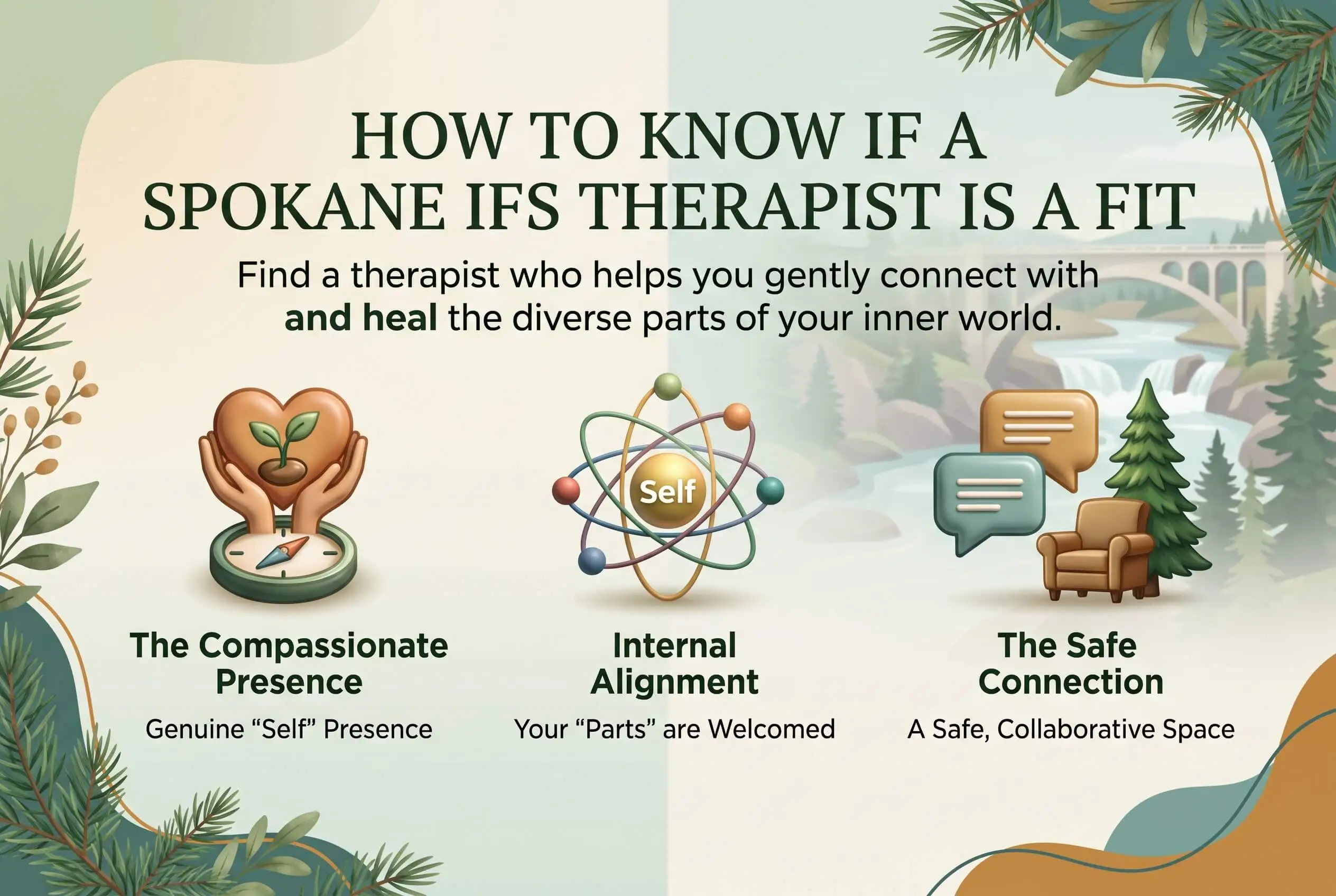
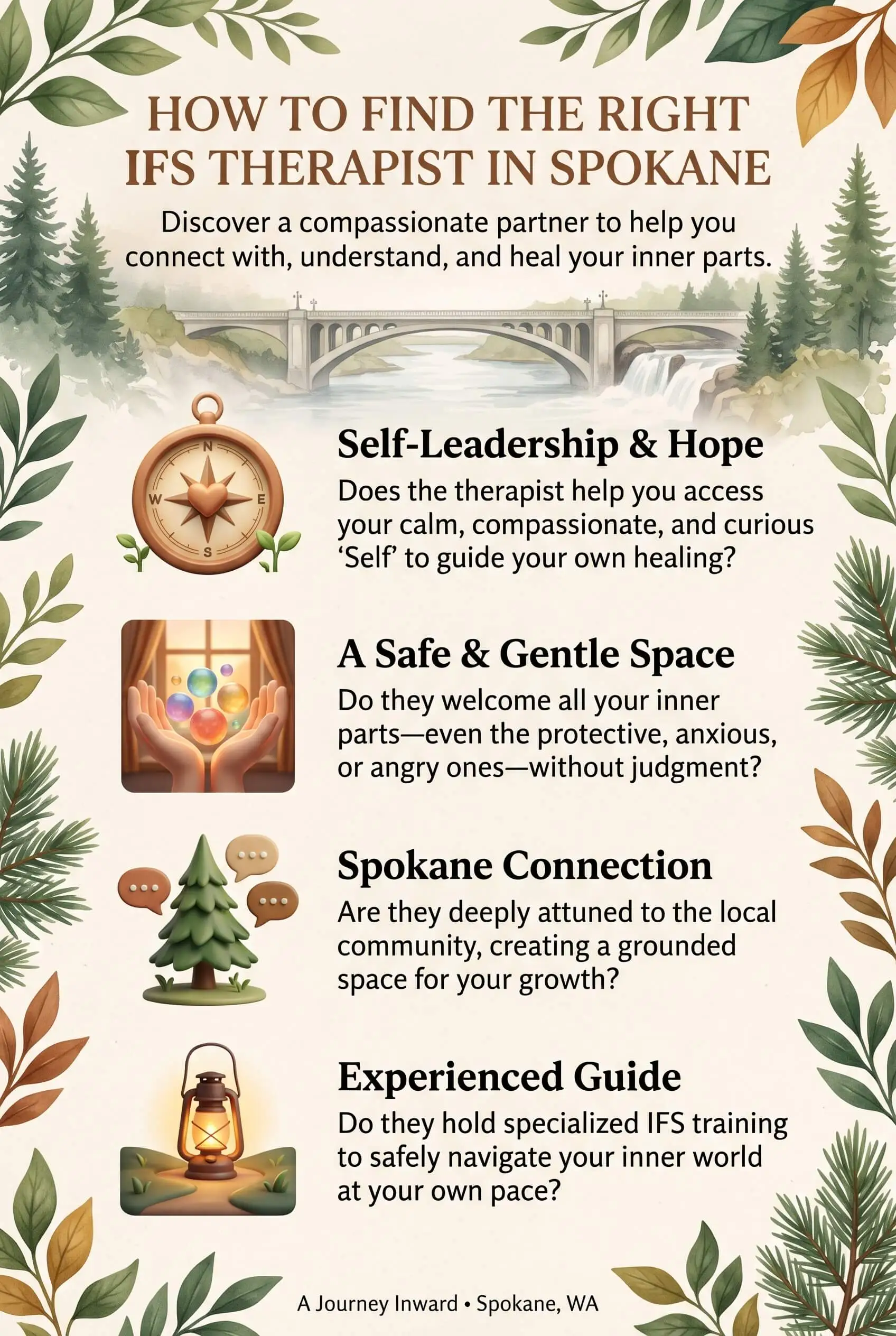
They state their IFS training plainly. The IFS Institute trains therapists in three levels, and certification is a separate step on top of those. A good therapist names their level without hedging and holds a Washington license you can look up yourself.
Their focus sounds like your life. Trauma, anxiety that hides under a calm surface, perfectionism, attachment wounds. A short, specific list usually means years spent in that work. A page listing thirty specialties usually means less.
They tell you who they don't see. Couples, kids, medication management. Someone who names their limits on the first call is showing you how they'll handle hard truths later.
You hang up steadier than when you dialed. Most people can feel this within ten minutes. Trust it over anything written on a profile.
Nobody promises you an outcome. No honest therapist can tell you how long healing takes. In parts work, a slow pace is part of the care, so be a little wary of anyone selling speed.
Questions to Ask a Spokane Therapist on Your Consult Call
How a therapist answers these matters as much as what they actually say.
What IFS training have you completed? Listen for a specific level and where they trained, offered without defensiveness.
What happens if part of me doesn't trust this? A good answer welcomes that part and slows down to meet it.
What does a first session usually look like? You want to hear something quiet and unhurried, led mostly by what you bring.
Who isn't a good fit for you? Expect a clear, honest list and an offer to point you somewhere else.
Are you in-network with my plan, or can you give me a Good Faith Estimate? Either a direct answer on insurance or a written cost estimate before you start.
Reading these off your screen during the call is completely fine. Most therapists are glad when someone shows up with questions.
Red Flags Worth Noticing Early
A few signals suggest it's worth continuing to look:
Pressure to book a block of sessions before the consult is over
A promised timeline or a guaranteed result
A therapist who treats your hesitation as resistance to push through
Credentials that don't match what the Washington license search shows
None of this makes someone a bad person. It just makes it less likely your guarded parts will ever relax enough to let the work happen.
IFS Therapy for Adults (Virtual): When You Don't Live in Spokane
You can work with a Spokane therapist from anywhere in Washington, as long as you're physically in the state during sessions.
Washington licensure follows where the client is sitting. So someone in Seattle, Tacoma, the Tri-Cities, or a small town with one clinic and a six-month waitlist can see a Spokane-based IFS therapist by video.
Many adults find video easier anyway. You skip the drive across the Monroe Street Bridge in January, and you skip the waiting room. A quiet corner of your own home and a door that closes is enough.
Lauren Rath, a licensed mental health counselor based in Spokane, offers IFS therapy for adults (virtual) anywhere in Washington State. Her practice centers on adults working through trauma, anxiety, perfectionism, and attachment wounds. She's also upfront on the first call about who she isn't the right therapist for.
How to Check a Therapist's Credentials in Washington
Checking a Washington therapist takes about five minutes.
Look up the license. Search their name in the Washington State Department of Health provider credential search and confirm the license is active.
Ask about IFS training. Compare what they tell you with their IFS Institute directory listing. The Institute relies on self-reported credentials, so asking directly still matters.
Settle cost before the first session. Ask whether they're in-network with your plan. If you're paying out of pocket, federal law entitles you to a written Good Faith Estimate before care begins.
Run this check on every therapist on your list, including the ones who seem beyond question. Lauren Rath invites people to run it on her, too.
"In my experience, people don't really choose a therapist by reading. They choose in the first few minutes of hearing a voice. On every consult call, I ask people to notice whether their shoulders drop or climb. If a guarded part relaxes even a little in fifteen minutes, that tells you more than my credentials can. And if it doesn't relax with me, that's useful information too. Keep looking."
7 Essential Resources
Worth a few minutes before you book anyone.
Learn What IFS Training Levels Mean
The IFS Institute directory explains its three training levels and how certification differs from training. You can also search it for IFS-trained providers around Spokane or anywhere in Washington. The Institute relies on what providers report about themselves, so treat a listing as a starting point.
Source: IFS Institute Practitioner Directory
Search the Directory for What You Actually Need
This short help article shows how to search by location and add keywords like trauma or a specific insurance plan. It also reminds you to contact providers directly about fit, fees, and openings.
Source: How to Use the IFS Practitioner Directory
Verify Any Washington Therapist's License
The Washington State Department of Health keeps a public credential search. Type in a name or credential number and you'll see whether the license is active, what type it is, and whether there's any public disciplinary history.
Source: Provider Credential Search
Bring Better Questions to Your First Call
The National Institute of Mental Health lists questions worth asking a prospective therapist, from credentials and approach to how you'll both know whether it's working. NIMH also states plainly that rapport and trust are essential.
Source: NIMH: Psychotherapies
Decide Whether Video Therapy Suits You
NIMH's fact sheet on virtual care lays out the benefits and the drawbacks of telehealth, plus what to look for in a provider who works online. Helpful if you've never done therapy over video.
Source: Getting Mental Health Support Virtually
See What Help Washington Offers
The Washington Office of the Insurance Commissioner gathers behavioral health resources on one page, including crisis lines, Apple Health, TRICARE, and VA options. Keep it open while you check what your plan covers.
Source: How to Get Help With Behavioral Health
Ask for a Written Estimate Before You Pay
If you're paying without insurance, federal law entitles you to a Good Faith Estimate before care starts. This CMS toolkit explains the protection, shows a sample estimate, and covers what to do when a bill comes in well above it.
Source: No Surprises Act Consumer Advocate Toolkit
3 Statistics
Each of these numbers bears on the decision you're making right now.
The Relationship Predicts How Therapy Goes, on Video or in Person
A 2018 meta-analysis of 295 studies covering more than 30,000 patients found a steady link between the strength of the therapist-client alliance and treatment outcomes (r = .278). For internet-based therapy, the link was nearly identical (r = .275). So fit is one of the most studied predictors of whether therapy helps, and moving it onto a screen doesn't weaken it.
Source: The Alliance in Adult Psychotherapy: A Meta-Analytic Synthesis (Flückiger et al., 2018)
About One in Seven Adults Saw a Therapist in 2024, Fewer Outside Cities
The National Center for Health Statistics found that 14.0% of U.S. adults received counseling or therapy from a mental health professional in 2024. In nonmetropolitan areas the figure fell to 10.6%, against 15.2% in large central cities. Across much of rural Washington, statewide video care exists to close exactly that gap.
Source: NCHS Data Brief No. 564: Mental Health Treatment Among Adults, United States, 2024
More Than One in Five Adults Lives With a Mental Illness, and About Half Get Treatment
NIMH estimates that 59.3 million U.S. adults, or 23.1%, lived with a mental illness in 2022, and 50.6% of them received any mental health treatment that year. Lauren Rath puts that gap down to cost, waitlists, and the dread of being judged by the one person you finally tell, far more than any lack of willingness.
Source: NIMH: Mental Illness Statistics
Research shows that a strong therapist-client relationship is closely linked to better treatment outcomes, whether sessions happen online or in person. With 14% of U.S. adults receiving therapy in 2024 and nearly half of adults with mental illness going without treatment in 2022, access to trusted healthcare professionals through virtual therapy can help address barriers such as location, cost, waitlists, and fear of judgment.
Final Thoughts and Opinion
By the time someone lands on a page about IFS therapy like this, they've usually done plenty of reading. The deciding factor tends to be smaller and quieter than research: whether the person on the other end of the call sounds like someone you could eventually tell the truth to.
Worth holding onto:
Check the license first, then trust what you felt on the call.
A therapist who names your exact struggle has usually spent years inside it.
In parts work, a slow pace is part of the care.
Switching after a poor fit is normal, and good therapists expect it.
Here's the opinion we'll stand behind: most people wait too long for a feeling of readiness that tends to show up only after the first conversation. Almost everyone who books a consult has some part that thought it was a bad idea.
That part is allowed to come along. It might even help you choose.
Frequently Asked Questions
How many sessions does it take to know if an IFS therapist is a good fit?
A free 15-minute consult gives you a first read, and a few sessions in you'll usually have a clearer picture. Watch whether your guarded parts soften or brace. If you keep feeling like you're doing therapy wrong, say so to the therapist directly, or treat it as a sign to look elsewhere.
What do IFS Institute training levels mean?
The IFS Institute trains therapists in three levels. Level 1 is the foundation, and Levels 2 and 3 build on it. Certification is a separate process that requires at least Level 1. Because the Institute's directory relies on self-reported credentials, ask any therapist what they've completed.
Does IFS therapy work as well online as in person?
Many people find parts work translates well to video, partly because they're sitting in their own space. A 2018 meta-analysis of 295 studies found the link between the therapy relationship and outcomes was about as strong online as face to face. The relationship counts for more than the room.
Can a Spokane therapist see me if I live elsewhere in Washington?
Yes, as long as you're physically in Washington during each session and the therapist holds a Washington license. Licensure follows where the client sits, so someone in Seattle or a small coastal town can work with a Spokane-based therapist by video.
Does insurance cover IFS therapy in Washington?
Coverage usually depends on the therapist's license and your plan's mental health benefits, more than on the approach they use. Ask whether the therapist is in-network with your plan. If you're paying out of pocket, you're entitled to a written Good Faith Estimate before care begins.
Is it okay to switch therapists if the fit feels wrong?
Yes. Good therapists expect it, and many will help you find someone better suited. In parts work especially, finding a person your protective parts can trust is part of the work itself.
Start With One Short Conversation
You don't have to decide everything tonight. Pick one Spokane therapist whose focus sounds like your life, check the license, and book a free 15-minute consult. Then let the call answer the fit question.
If you'd like somewhere to start, Lauren Rath sees adults by video anywhere in Washington, and nothing gets decided on that first call.
Choosing who to trust with something personal works much the same way in other parts of life. If you're weighing a different kind of specialist, our guide to what makes a top Beverly Hills nose surgeon the best choice walks through a similar decision.


